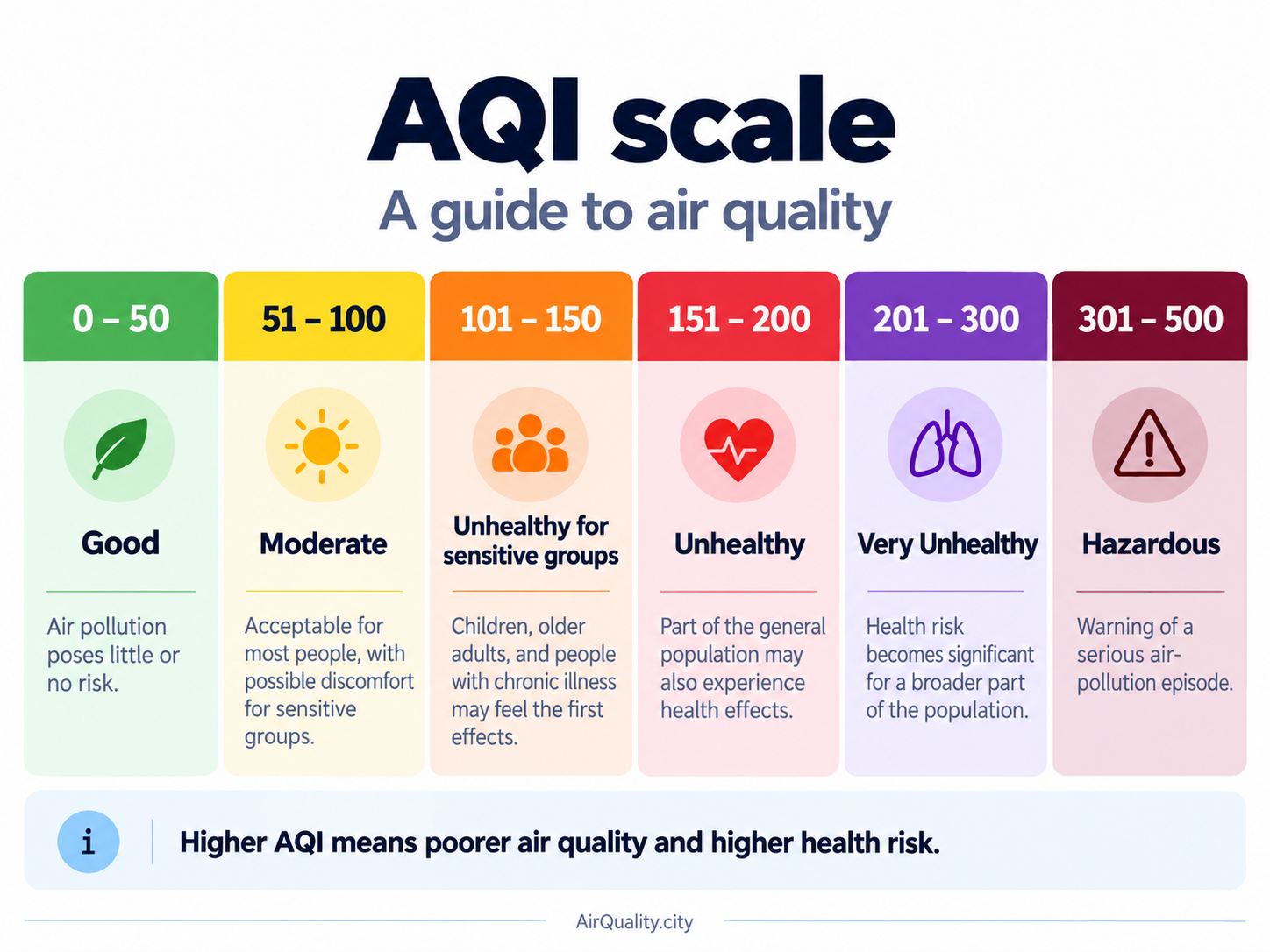
AQI scale and the meaning of each category
AirQuality.city uses the U.S. EPA numerical scale and concentration breakpoints for PM2.5 and PM10. The scale runs from 0 to 500 and is divided into six categories designed to provide a quick health-oriented description of current pollution levels.[1]
| AQI | Category | General meaning |
|---|---|---|
| 0-50 | Good | Pollution is low and the expected risk is small. |
| 51-100 | Moderate | Air is acceptable for most people, although unusually sensitive individuals may notice effects sooner. |
| 101-150 | Unhealthy for Sensitive Groups | Children, older people and those with heart or lung conditions may be more affected by prolonged or intense exposure. |
| 151-200 | Unhealthy | Health effects become possible in the general population, with greater risk for sensitive groups. |
| 201-300 | Very Unhealthy | Risk is increased for everyone and outdoor exposure deserves more serious restriction. |
| 301-500 | Hazardous | Very high pollution levels with potential effects across the population. |
The category boundaries are 50, 100, 150, 200 and 300. A value of 50 is still Good, while 100 is still Moderate.[1]
The same AQI value represents different concentrations for PM2.5 and PM10
AQI is not a direct measurement. Each pollutant has its own concentration breakpoints that are mapped onto the common AQI categories.
For the current U.S. EPA particulate-matter breakpoints, the table is:[3]
| AQI category | PM2.5 µg/m³ | PM10 µg/m³ |
|---|---|---|
| Good | 0.0-9.0 | 0-54 |
| Moderate | 9.1-35.4 | 55-154 |
| Unhealthy for Sensitive Groups | 35.5-55.4 | 155-254 |
| Unhealthy | 55.5-125.4 | 255-354 |
| Very Unhealthy | 125.5-225.4 | 355-424 |
| Hazardous | 225.5-325.4 | 425-604 |
In the official US system, these breakpoints are applied with defined averaging rules. AirQuality.city currently uses them to convert the latest processed PM value into a fast local indicator, so the result is not the same as the official daily AQI or the AirNow NowCast.[2]
A colour boundary is not a wall
The categories are useful communication tools, but pollution changes continuously in the real atmosphere. AQI 100 and AQI 101 sit on opposite sides of a defined boundary even though the physical difference in the air is very small.
When values are close to a boundary, the direction of travel and the underlying concentration are usually more informative than treating a colour change as a sudden jump in risk.
The European scale uses different thresholds
The European Air Quality Index does not use the same six numerical bands. The EEA presents Good, Fair, Moderate, Poor, Very poor and Extremely poor, and the station result can be driven by PM2.5, PM10, NO₂, O₃ or SO₂.[4]
The difference is especially visible at lower PM2.5 concentrations. The European Good band for PM2.5 ends at 5 µg/m³, whereas the U.S. EPA Good band extends to 9.0 µg/m³.[4][3]
Colours from two services therefore should not be compared without first checking the methodology. The most solid common reference is the underlying concentration in µg/m³.
Health meaning also depends on the person and duration of exposure
An AQI category is a public-health guide, not a diagnosis. Individual response depends on health status, age, physical activity and how long exposure lasts. When pollution remains elevated for hours or days, the duration and trend become as important as any single reading.
During more serious episodes, health advice from competent public authorities should take priority, particularly for children, older people and those with cardiovascular or respiratory disease.
Sources
- AQI BasicsU.S. EPA AirNow Accessed 2026-09-26
- Using the Air Quality IndexU.S. EPA AirNow Accessed 2026-09-26
- AQI BreakpointsU.S. Environmental Protection Agency Accessed 2026-09-26
- European Air Quality IndexEuropean Environment Agency Accessed 2026-09-26