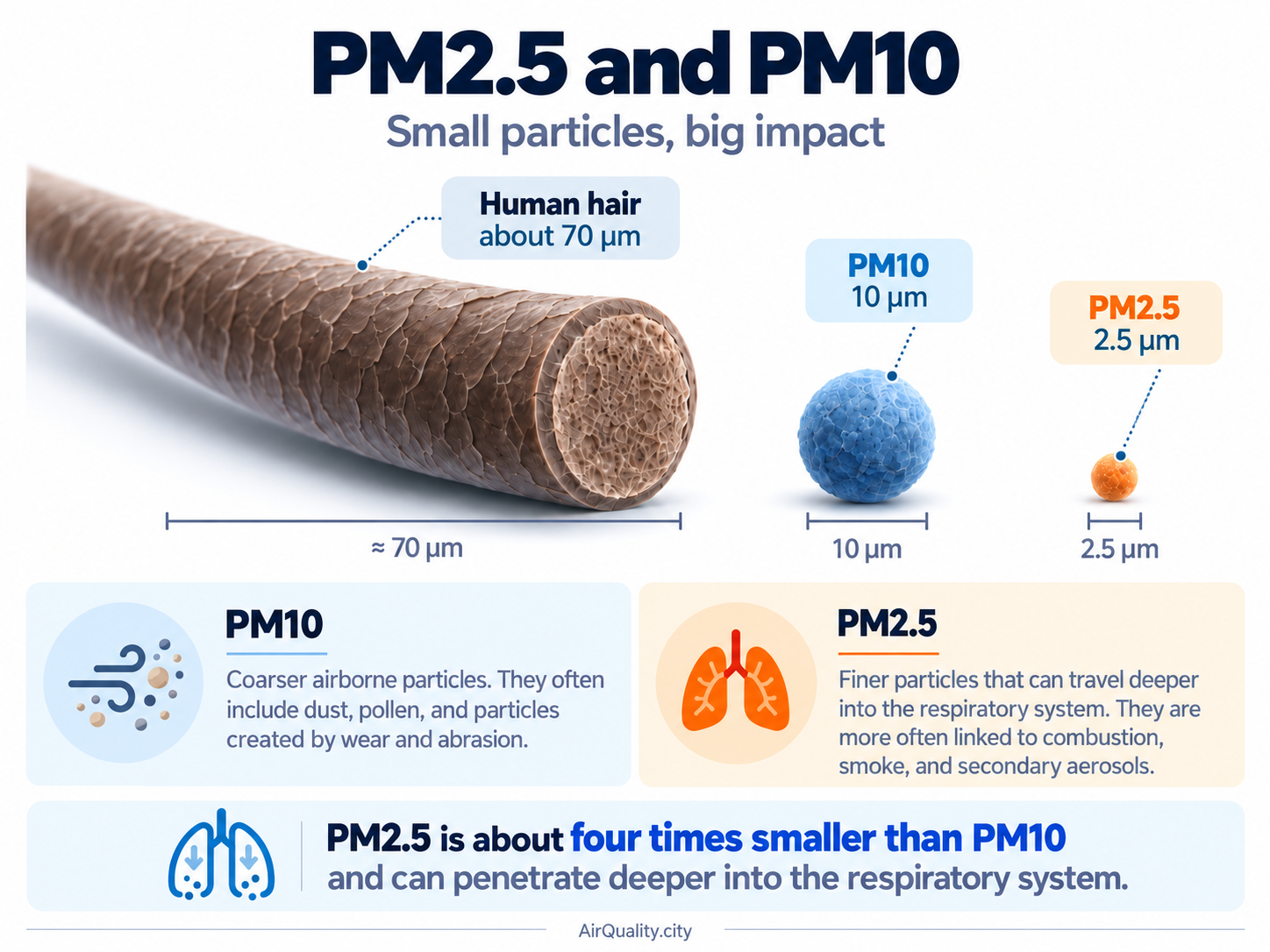
PM2.5 and PM10: small particles with different sources and risks
PM2.5 and PM10 often appear side by side on the same air-quality map, which makes them easy to treat as two versions of the same measurement. In reality, both describe mixtures of particles grouped by size, and that size strongly affects where the particles come from, how long they remain airborne and where they can travel in the respiratory system after inhalation.
PM10 includes particles with an aerodynamic diameter up to 10 micrometres. PM2.5 is the finer fraction, up to 2.5 micrometres. In simple terms, PM2.5 sits within the PM10 fraction, although different instruments and measurement methods can produce small short-term differences in reported values.
The same PM label can hide very different chemistry
Particulate matter is not one substance. It can contain sulphates, nitrates, ammonium, black carbon, mineral dust, organic material, salts, metals and water, with composition depending on source and atmospheric processing.[1]
A high PM2.5 concentration therefore cannot by itself prove that wood burning, traffic or industry is responsible. Likewise, a rise in PM10 does not automatically prove Saharan dust. Concentration tells us how much particulate matter of a given size is present, not what it is chemically made of.
Combustion often raises the fine PM2.5 fraction
Smoke from domestic heating, fires, traffic and other combustion processes can contain a large share of fine particles. Because of their small size, PM2.5 can remain suspended for longer and travel well beyond the immediate source.
PM10 includes that fine fraction but also larger particles associated with road and soil dust, construction, mechanical wear and natural aerosols. During dry and windy conditions, PM10 can therefore rise sharply without a comparable increase in PM2.5.
The relationship between PM2.5 and PM10 can provide a useful clue, but it is not a chemical fingerprint. Reliable source attribution needs additional evidence.
Smaller particles can penetrate deeper into the body
Size matters for health as well as measurement. Fine PM2.5 can reach deep into the lungs, and some very small particles and their constituents can cross the lung barrier and enter the bloodstream. Both short- and long-term exposure to particulate matter are associated with cardiovascular and respiratory effects, which is why WHO treats particulate pollution as a major indicator of the health burden from dirty air.[1]
PM10 is not harmless simply because the particles are larger. Coarser particles can still irritate the eyes and airways and aggravate existing respiratory problems.
Concentrations can change quickly
PM concentration is not a permanent characteristic of a city. It can rise after domestic heating starts, after a wind shift, during smoke transport, when dust is resuspended or under a temperature inversion, and then fall rapidly when atmospheric mixing improves or rain arrives.
A high reading therefore needs a time context. A short spike at one location and an elevated concentration lasting for hours across an entire area are not the same event.
Optical sensors track trends well, but they have limitations
SensorBox uses optical particle sensing. These sensors estimate concentration from the way particles scatter light, so readings can be affected by aerosol size and properties, relative humidity, fog, condensation, airflow and the condition of the sensor itself. The US EPA specifically identifies humidity, temperature and calibration as common challenges for low-cost sensor systems.[2]
That does not mean every disagreement is an error. It means an unusual value should be viewed as part of a time series, compared with nearby stations and checked against weather conditions.
PM2.5 and PM10 on AirQuality.city
AirQuality.city displays the concentration and a separate AQI for both particle fractions, with the less favourable result determining the station's overall PM index. That makes it easy to see which component is driving the display, but meaningful interpretation still begins with concentration, trend and location.
The useful distinction is not that one type of particle is "good" and the other "bad". Both matter; they describe different parts of the complex mixture we call particulate matter.
Sources
- Ambient (outdoor) air pollutionWorld Health Organization2024-10-24 Accessed 2026-09-26
- Frequent Questions About Air SensorsU.S. Environmental Protection Agency Accessed 2026-09-26