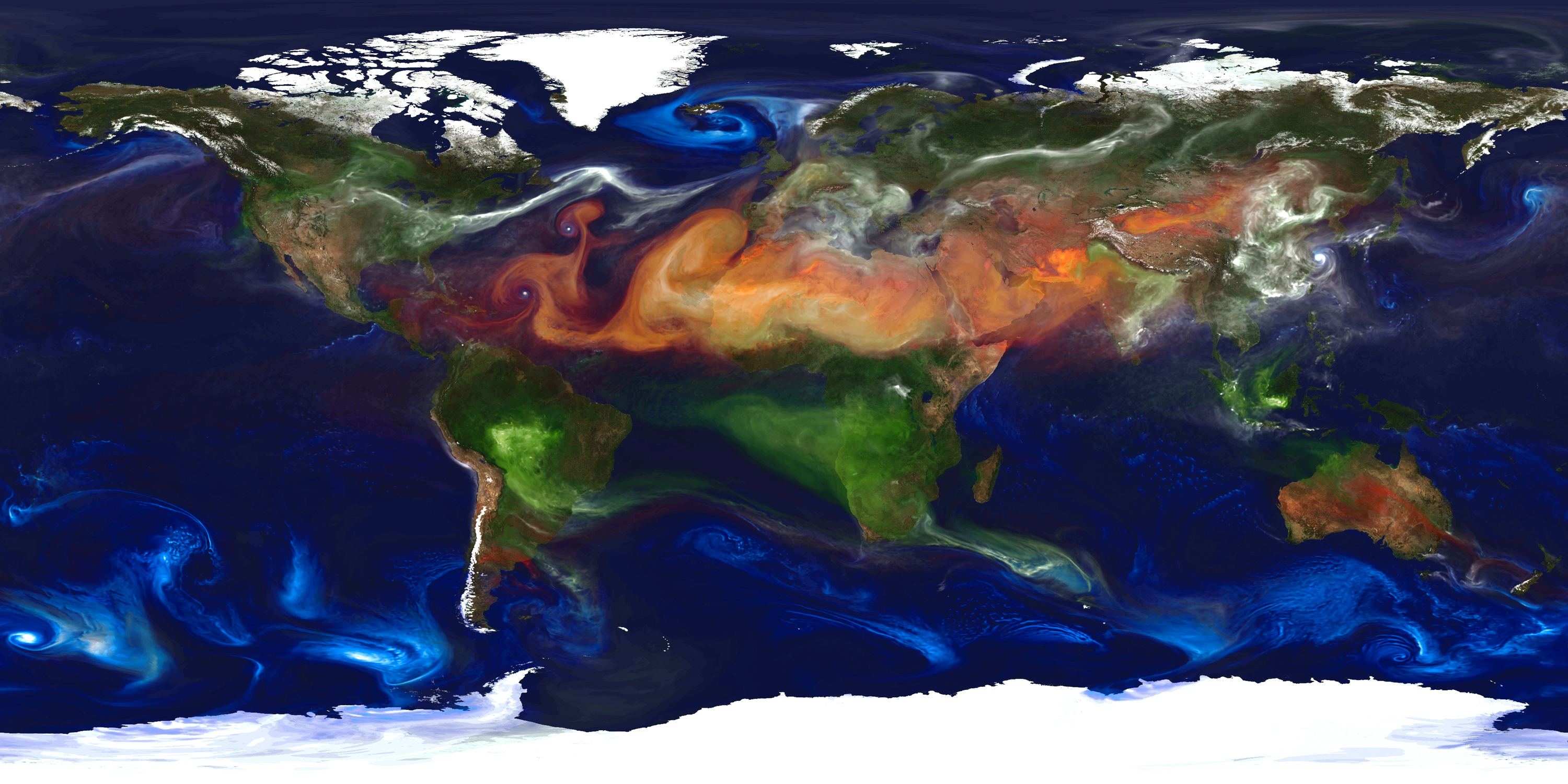
AQI turns pollutant concentrations into a simpler air-quality signal
AQI, the Air Quality Index, is an attempt to turn a complex measurement into something that can be understood in a few seconds. Instead of expecting a reader to know whether, for example, 28 µg/m³ of PM2.5 is low or high, the concentration is placed in a predefined band and given a simpler meaning.
That is useful, but it is not universal. There is no single AQI methodology used by every website. The U.S. EPA AQI and the European Air Quality Index differ in their thresholds, averaging periods, pollutant coverage and the way the final result is presented.[1][4]
AirQuality.city currently calculates its index from PM2.5 and PM10
AirQuality.city's SensorBox stations measure PM2.5 and PM10, so the website calculates a separate value for each fraction using U.S. EPA concentration breakpoints. The less favourable of the two becomes the station's overall result.
If PM2.5 is Moderate while PM10 is Good, the station will therefore be shown as Moderate. The approach makes it immediately clear which particle fraction is driving the result at that moment.
NO₂, O₃, SO₂ and CO can be displayed for official stations that measure them, but they do not currently enter the overall AirQuality.city AQI. The number should therefore be read as a particulate-matter index, not as a complete assessment of every substance that may be present in the air.
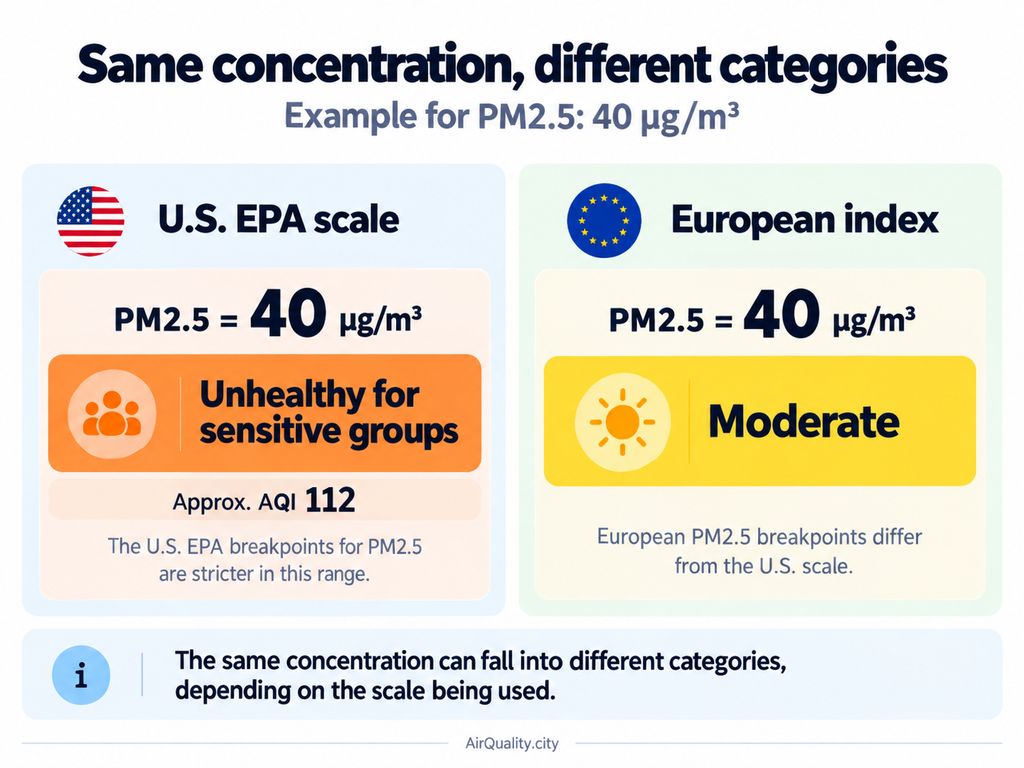
The US and European scales do not speak the same language
The U.S. EPA AQI uses a numerical scale from 0 to 500 with the categories Good, Moderate, Unhealthy for Sensitive Groups, Unhealthy, Very Unhealthy and Hazardous. For PM2.5, for example, the official EPA Good band ends at 9.0 µg/m³, while Moderate covers 9.1 to 35.4 µg/m³.[3]
The EEA's European index works differently. It uses the categories Good, Fair, Moderate, Poor, Very poor and Extremely poor, and the overall level is driven by the least favourable result among up to five pollutants: PM2.5, PM10, NO₂, O₃ and SO₂. For PM2.5, the European Good band ends at 5 µg/m³, Fair covers 6 to 15 µg/m³, and Moderate 16 to 50 µg/m³.[4]
The same air can therefore receive a different colour or label on two services even when the underlying concentration is correct on both. A different result is not necessarily an error; it often reflects a different methodology.
AirQuality.city does not currently claim to reproduce the full European index
The reason is mainly technical and transparent. SensorBox currently measures PM2.5 and PM10, while the European index is designed around a broader pollutant set and, depending on station type, applies minimum data-availability requirements.[4]
It is possible to apply the European bands to PM2.5 or PM10 alone and show a European-style PM category, but that is not the same as a complete European Air Quality Index. AirQuality.city therefore retains its current PM-based display for now and states clearly what enters the result and what does not.
The website does not reproduce the official EPA NowCast
There is another difference hidden behind the same AQI label. The official US current-particle display uses NowCast, a method that incorporates several previous hours and changes their weighting according to how quickly concentrations are moving.[2]
AirQuality.city currently applies EPA concentration breakpoints to the latest processed PM value available to the website. That provides a fast local signal, but it is not the official AirNow NowCast and it is not the same as the daily AQI. The AirQuality.city number should therefore not be compared with an official US AQI as though both were calculated by an identical procedure.
Concentration remains the underlying measurement
AQI is useful because it makes the data quicker to read. The concentration in µg/m³ remains the measurement from which the index is derived, and both are worth checking when the details matter.
If two services show similar concentrations but different colours, they are probably using different thresholds or index rules. If the concentrations differ as well, the useful questions concern the station, measurement time, averaging period and data source.
AQI works best as a signpost. A fuller picture comes from adding concentration, trend, station location, weather and any additional pollutants measured at that site.
Sources
- AQI BasicsU.S. EPA AirNow Accessed 2026-09-26
- Using the Air Quality IndexU.S. EPA AirNow Accessed 2026-09-26
- AQI BreakpointsU.S. Environmental Protection Agency Accessed 2026-09-26
- European Air Quality IndexEuropean Environment Agency Accessed 2026-09-26