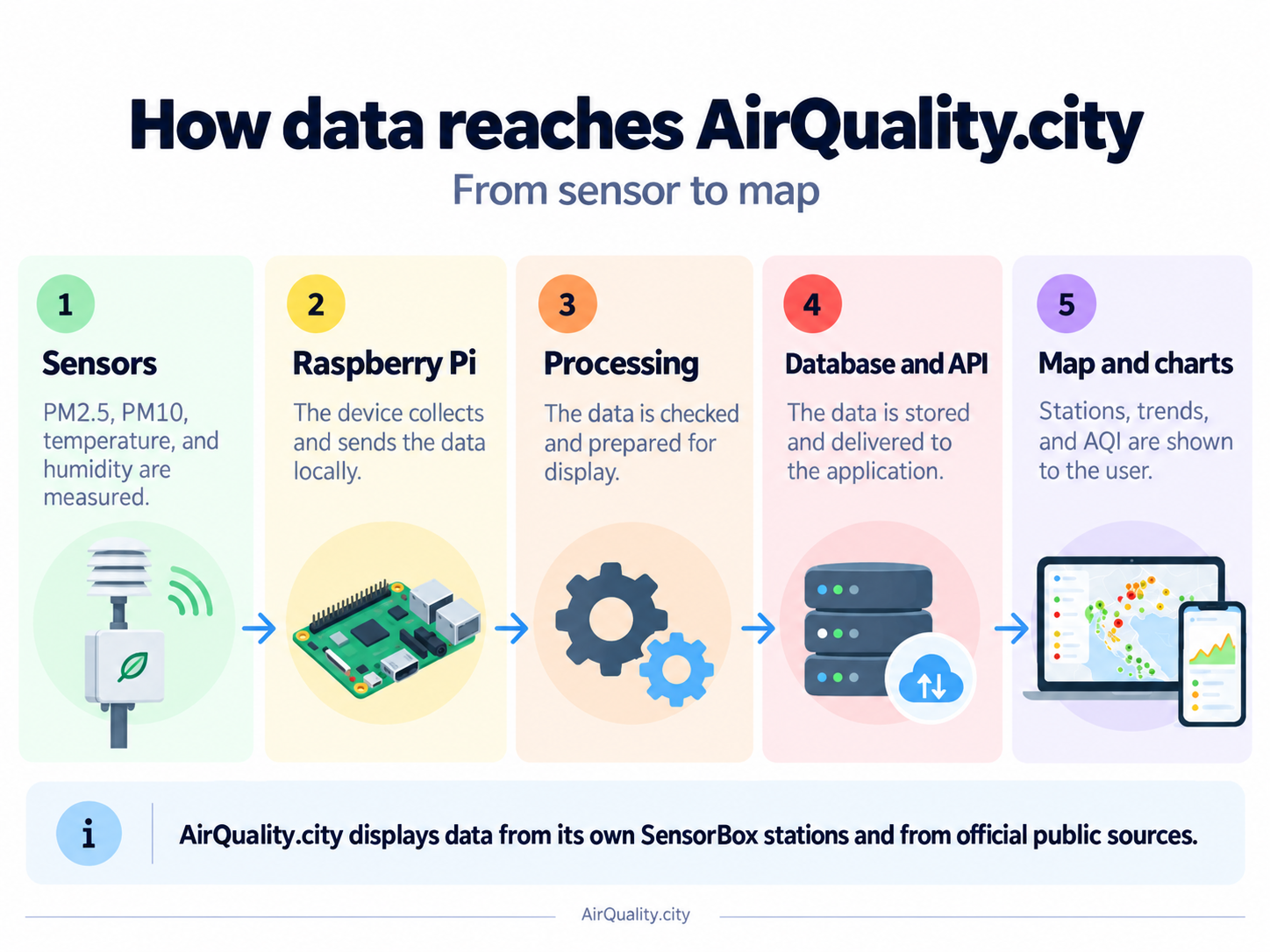
From sensor to map: how data moves through AirQuality.city
A number on a map looks simple, but it passes through several different systems before it reaches the screen. AirQuality.city combines its own SensorBox stations with publicly available data from official monitoring networks, and those two data streams do not use the same equipment, serve the same purpose or pass through the same quality-control process.
That difference is not something to hide. A useful monitoring network begins with a clear understanding of what was measured, how it was measured and how much weight a single reading can reasonably carry.
SensorBox tracks local changes in PM2.5 and PM10
The project's own stations use optical particulate-matter sensors. Particles scatter light inside the measurement chamber, and the electronics use that signal to estimate PM2.5 and PM10 concentrations. This technology makes small, relatively affordable and frequently sampled stations possible, which is why it works well for a denser local network.
A low-cost sensor, however, is not the same instrument as a regulatory analyser. Relative humidity, temperature, fog, enclosure position, airflow, contamination and a very nearby pollution source can all influence the result. The US EPA therefore describes such sensors as useful for informational and supplemental monitoring while stressing that performance varies and that real-world evaluation matters for more demanding applications.[1]
In practical terms, SensorBox is useful for the job it was built to do: following trends, detecting local changes and revealing patterns over time. A single isolated value, particularly in fog or close to a smoke source, deserves more caution.
Official stations serve a different purpose
Official monitoring networks use standardised instruments and quality-control procedures intended for regulatory monitoring. Depending on the site, a station may measure PM2.5, PM10, NO₂, O₃, SO₂, CO and a range of other pollutants. Croatia's public system publishes operational data in near real time while explicitly noting that those values may later change during validation.[2]
AirQuality.city imports and displays those data alongside its own stations. That gives users denser local information where SensorBoxes exist and a broader pollutant picture where official instruments provide it.
The same city does not mean the same measurement location
A difference between two stations is often not an error at all. A sensor beside a busy road can record a different pattern from a station in a residential neighbourhood, and both readings can be correct for their respective locations.
Distance from roads and chimneys, sensor height, surrounding buildings, terrain, wind direction and atmospheric mixing all influence a measurement. AirQuality.city therefore treats a station as a measurement of a particular place, not as a universal value for an entire city.
Time matters as much as the number
Air quality can change within tens of minutes. A shift in wind, the evening start of domestic heating or an arriving smoke plume can raise or lower concentrations quickly, so a reading without a timestamp loses much of its meaning.
The previous hours are therefore often more informative than the latest point alone. A brief spike that disappears immediately tells a different story from a steady rise lasting all evening, just as a local increase at one station differs from a simultaneous increase across a wider area.
Weather changes both the air and the way a sensor sees it
Wind often helps disperse local pollution, but it can also carry smoke or dust from far away. Rain can remove particles from the atmosphere, while a temperature inversion can hold pollution close to the ground for hours.
High humidity adds another complication. In optical PM sensors, water droplets and hygroscopic growth can alter the apparent particle signal. During dense fog it is therefore especially useful to compare several stations and see whether low-cost and reference instruments are showing the same broad pattern.[1]
Data is only as useful as its explanation
AirQuality.city does not try to erase the distinction between SensorBox and an official monitoring station. The local network provides density and fast readings; official stations provide regulatory-grade monitoring, a broader pollutant set and validated records.
Viewed together, with time, location and weather in mind, those two types of data can provide a more useful picture than any isolated number on its own.
Sources
- Frequent Questions About Air SensorsU.S. Environmental Protection Agency Accessed 2026-09-26
- Kvaliteta zraka u Republici HrvatskojMinistarstvo zaštite okoliša i zelene tranzicije Accessed 2026-09-26