Taking a child out when the air is polluted: shorter, slower and, if possible, in the afternoon
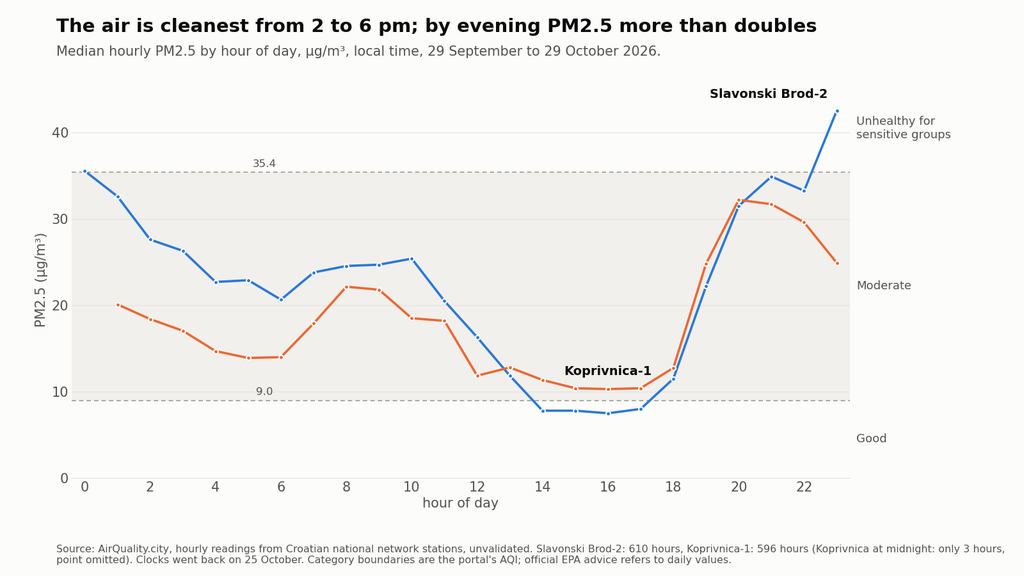
If you can take your child out either in the afternoon or in the evening, choose the afternoon. From late September to late October 2026, the evening air in Slavonski Brod and Koprivnica, two towns in eastern and northern Croatia, was two to three times more polluted than in the afternoon, almost every day[1].
The pollution in question is fine particles: soot, smoke and dust too small to see, which reach deep into the lungs. In the evening, homes light their stoves, the wind often drops and cold air keeps the smoke close to the ground. We explain this in our frequently asked questions and in our piece on winter evenings.
In the afternoon, the air at both stations was almost always good or moderate. In the evening, roughly one hour in four was bad for children and other sensitive people, and sometimes for everyone. Mornings were not clean either: in Slavonski Brod the morning air was, on average, almost as bad as the evening air[1].
That is what one month in two towns showed. November and December may look different, and the US Environmental Protection Agency (EPA) warns that the air can be bad at any time of day[7].
Children breathe in more air than adults
Children breathe faster than adults, so they take in more air and more pollution with it. They are closer to the ground, spend a lot of time playing outside, and their lungs are still developing, the World Health Organization (WHO) explains[2]. The European Environment Agency (EEA) adds that children breathe more through the mouth, so pollution gets deeper into the lungs[3].
According to the WHO, there is strong evidence that polluted air weakens children's lungs and slows their development, even when pollution is not high. It also raises the risk of asthma and makes existing asthma worse[2].
When the air is worse, more children with asthma end up in emergency departments
In 2016, Korean researchers pooled the results of 26 studies. On days with more fine particles in the air, children were somewhat more likely to be admitted to hospital or seen in an emergency department for asthma. The link was strongest in children under five[4]. It is an average across many children and cannot tell you how likely your own child is to have an attack.
For winter the picture is less clear. Only seven studies covered the cold months, and in them the link was not reliable enough to count[4]. There is simply less research on winter, so the estimate is less certain.
Exercise pays off for adults even in poorer air; for children less is known
For adults, researchers have calculated that walking and cycling do more good than harm even in a fairly polluted city. The harm only wins in heavily polluted air, and after an hour and a half of cycling a day[5]. That calculation is about years of living in a city, not about one smoky evening. For children and other sensitive groups the evidence is thin, the same author and colleagues wrote later[6].
The EPA starts from the view that children need at least an hour of physical activity a day. It does not set a limit on how long they may stay outside when the air is bad. The worse the air, the more breaks and the easier the pace it advises. A child who runs and gets out of breath takes in more pollution, so walking is better than running[7].
What the EPA advises at each level on the map
The portal uses the US scale, under which all children count as a sensitive group[8]. The European and British scales count only children with lung or heart conditions as sensitive[9][10]. The EPA's advice to schools is this[7]:
- Good and moderate: children can play outside as usual.
- Unhealthy for sensitive groups: children can spend shorter periods outside, such as break time or a PE lesson. Children with asthma should keep their reliever with them.
- Unhealthy: longer or strenuous play and training are better moved indoors or postponed.
- Very unhealthy and hazardous: children should stay indoors[8].
The advice refers to a whole day, while the map shows the latest measured hour, so one bad hour is not yet a bad day. If a child coughs, wheezes or struggles to breathe, even without asthma, they need a break or to go inside, and a doctor if it does not settle[7].
Away from the road there are fewer exhaust fumes, but chimney smoke is everywhere
The further you are from a road, the less exhaust gas there is, but not fewer fine particles, a review of more than 40 studies found[11]. Outside a school at drop-off time there can be around three times more fine particles than usual, and quieter streets away from queuing cars help, the EEA notes[3]. The EPA advises keeping children from playing near idling cars and buses or busy roads, especially at rush hour[7].
Evening chimney smoke covers a whole neighbourhood, so a park far from the road probably offers little protection from it. That is our own inference; we found no measurements that test it. Being indoors is not automatic protection either: when there are many particles outside, the EPA warns, there can be many inside too[8]. A mask is no answer for a small child. According to the EPA, certified masks do not come in sizes for small children, and a child easily pulls off a mask that does not fit[12].
Croatia does not yet warn people about particles
Croatian rules currently require the public to be warned when there is too much of certain gases in the air, but not of particles[13]. The new EU air quality directive changes that and introduces warnings for particles too[14]. Member states must bring it into national law by 11 December 2026. By the time this piece was published, we had not found a Croatian regulation that does so.
Nor, as far as we could find, does the Croatian Institute of Public Health (HZJZ) give parents advice by pollution level. In January 2020, Zagreb's Andrija Štampar Teaching Institute of Public Health advised children and other sensitive groups to avoid long or strenuous time outdoors when the air was bad, especially near busy roads, tportal reported[15].
Check the map before you go out
On the air pollution map, open the nearest station, for example Slavonski Brod-2 or Koprivnica-1, and see how the air has changed over the last few hours. National network stations publish readings two to three hours late, and the portal has no air quality forecast. When the air at a station turns unhealthy, it appears on the warnings page.
Sources
- Satne vrijednosti PM2,5, 29. rujna do 29. listopada 2026.: Slavonski Brod-2 i Koprivnica-1AirQuality.city Accessed 2026-10-29
- Air pollution and child health: prescribing clean air. SummaryWorld Health Organization2018-07-10 Accessed 2026-10-29
- Air pollution and children's healthEuropean Environment Agency2023-04-24 Accessed 2026-10-29
- Short-term Effect of Fine Particulate Matter on Children’s Hospital Admissions and Emergency Department Visits for Asthma: A Systematic Review and Meta-analysisJournal of Preventive Medicine and Public Health2016-07-30 Accessed 2026-10-29
- Can air pollution negate the health benefits of cycling and walking?Preventive Medicine2016-06-01 Accessed 2026-10-29
- Air pollution, physical activity and health: A mapping review of the evidenceEnvironment International2021-02-01 Accessed 2026-10-29
- Air Quality and Outdoor Activity Guidance for Schools (EPA-456/F-14-003)US Environmental Protection Agency2014-08-01 Accessed 2026-10-29
- Air Quality Guide for Particle Pollution (EPA-452/F-23-002)US Environmental Protection Agency2023-02-01 Accessed 2026-10-29
- European Air Quality IndexEuropean Environment Agency Accessed 2026-10-29
- Health advice for the Daily Air Quality Index (DAQI)UK Health Security Agency2026-04-13 Accessed 2026-10-29
- Near-Roadway Air Quality: Synthesizing the Findings from Real-World DataEnvironmental Science & Technology2010-06-18 Accessed 2026-10-29
- Protect Yourself From Wildfire Smoke and AshUS Environmental Protection Agency2026-07-24 Accessed 2026-10-29
- Uredba o razinama onečišćujućih tvari u zraku (NN 77/2020)Narodne novine2020-07-03 Accessed 2026-10-29
- Direktiva (EU) 2024/2881 Europskog parlamenta i Vijeća od 23. listopada 2024. o kvaliteti zraka i čišćem zraku za Europu (preinaka)Službeni list Europske unije2024-11-20 Accessed 2026-10-29
- Kvaliteta zraka u Zagrebu opet loša, osjetljive skupine građana trebaju izbjegavati tjelesne aktivnosti na otvorenomtportal.hr2020-01-23 Accessed 2026-10-29