Incinerators and air quality: measuring at the stack and in the neighbourhood
By 2035 Croatia may landfill no more than 10 per cent of the municipal waste it produces. The national Waste Management Plan for 2023 to 2028 is blunt about that target: it cannot be met without energy recovery, so plants for it have to be planned and built. The plan sizes the system at roughly 145,000 to 400,000 tonnes of mixed municipal waste a year, depending on the scenario, plus 100,000 tonnes of sewage sludge, measured as dry matter, in the larger one.[1]
The starting point is a long way off. In 2021 Croatia produced 1,004,877 tonnes of mixed municipal waste, and about 145,000 tonnes went through treatment plants, which by the plan's own reckoning means more than 85 per cent was landfilled untreated.[1] The amendments adopted in July 2025 left the energy-recovery chapter alone. They added clean-up of six contaminated privately owned sites, Gospić among them.[2]
One project has reached the design stage. In April 2024 the city of Šibenik signed a €2,948,000 agreement with the Environmental Protection and Energy Efficiency Fund to pay for design documentation for a plant at the Bikarac waste-management centre that would recover energy from refuse-derived fuel and dried sewage sludge. The Fund is covering the full cost.[3] Bikarac already produces refuse-derived fuel but, with no plant in Croatia to recover energy from it, exports it.[5] The documentation is being prepared by Ekonerg of Zagreb, which in March 2026 proposed grate combustion. Željko Kedmenec, who leads the studies, said then that the design would meet the strictest emission standards in force, and Bikarac's director, Robert Podrug, said they planned to submit the environmental impact assessment to the ministry before the summer.[4] We found no public record of whether it has been submitted. A public forum on the planned plant, set to cover how it would work and its possible effects on the environment and human health, was called for 22 October 2026 at the Arsen art house in Šibenik.[5] Emission figures have yet to come from the environmental impact assessment. They depend on the technology, the type and volume of waste, flue-gas cleaning and the site.
What the law requires at the stack
The EU Industrial Emissions Directive requires incineration and co-incineration plants to measure total dust, carbon monoxide, nitrogen oxides, sulphur dioxide, hydrogen chloride, hydrogen fluoride and total organic carbon continuously, with exemptions the authorities may grant for some of them. Furnace temperature and the oxygen, pressure, temperature and water-vapour content of the flue gas are logged continuously too, and the combustion gas must be held at 850 °C or more for at least two seconds.[6]
Heavy metals, dioxins and furans are measured periodically: at least twice a year, and every three months during the first 12 months of operation. The limit for dioxins and furans in the flue gas is 0.1 nanograms per normal cubic metre, averaged over a sampling period of six to eight hours. Since the directive was amended in 2024, emissions to air must also be monitored outside normal operating conditions, and those during start-up and shutdown, when no waste is being burned, are estimated from measurement campaigns carried out, for example, every three years.[6] For plants burning more than three tonnes of non-hazardous waste an hour, the 2019 best-available-techniques conclusions go further. Mercury is normally monitored continuously, and dioxins and furans are sampled over the long term every month on top of short-term measurements every six months, unless the operator shows that emissions are sufficiently stable.[7]
The stack and the street are different measurements
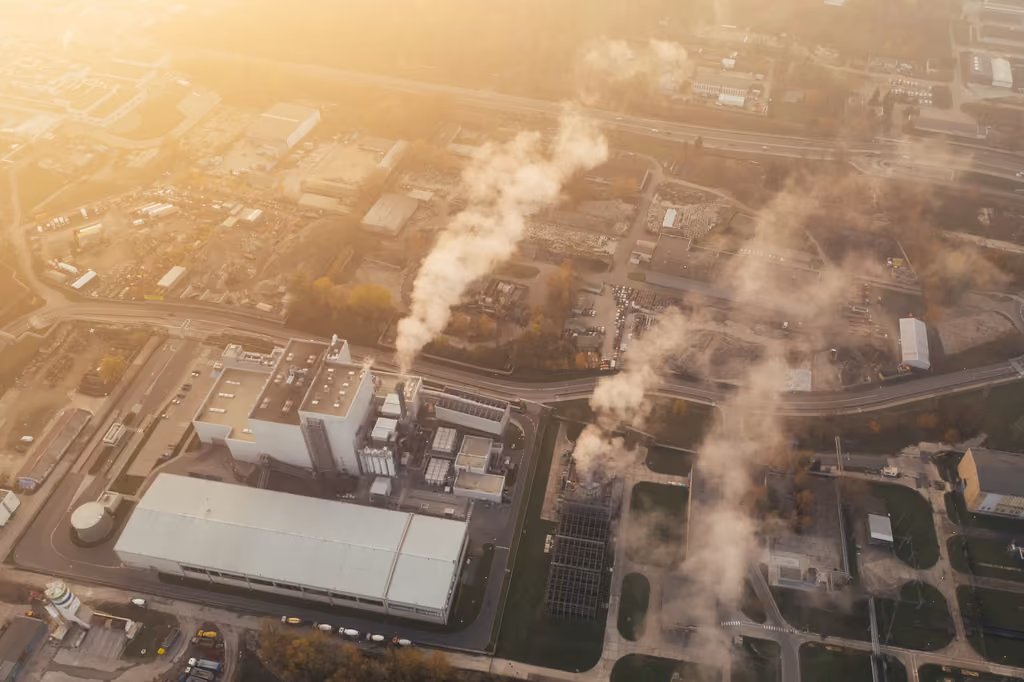
A stack measurement shows how much a plant releases, and at what concentration, before the plume is diluted. A monitor in a neighbourhood measures something else: the concentration of particular pollutants in the air people breathe at that spot. In between, the plume disperses, and how much of it reaches the ground depends on stack height, gas temperature, wind, atmospheric stability, terrain and distance. Assessing a plant's impact therefore means combining emissions data, weather, dispersion modelling and ambient monitoring.
AirQuality.city stations measure PM2.5 and PM10, and for some official stations the site also shows NO₂, O₃, SO₂ and CO when those data are available.[9] A sustained rise in particles near a plant would justify a closer look, but timing alone does not prove the cause: traffic, household heating, other industry, dust, fires and pollution carried in from far away all load the same air. The reverse can happen too, with a plant having a problem with a pollutant the nearby station does not measure at all. A PM sensor does not register hydrogen chloride, and heavy metals or dioxins bound to particles show up in its reading only as part of the total mass.[6][7]
Dioxins reach people mainly through food
According to the World Health Organization, more than 90 per cent of human exposure to dioxins comes through food, mainly meat, dairy products, fish and shellfish, because dioxins accumulate in animal fat. The WHO says uncontrolled incinerators are often the worst sources of dioxin release because burning in them is incomplete, and adds that technology exists to incinerate waste with low dioxin emissions.[12]
In April 2025 seven MEPs from the Left and Greens/EFA groups asked the European Commission about biomonitoring near incinerators in Ivry-sur-Seine, Zubieta and Harlingen and near a cement plant in Turňa nad Bodvou that also burns waste. They cited reports published on the website of Zero Waste Europe, an organisation that advocates managing waste without burning it.[10][11] The MEPs said high levels of heavy metals and persistent organic pollutants had been found in vegetation, soil and hens' eggs, and that dioxins in eggs often far exceeded EU limits.[10] The Commission replied in June that its industrial emissions expert group had been discussing the monitoring of biological markers around incinerators since 2022, and that the revised directive requires emissions of dioxins, furans and dioxin-like PCBs to be monitored outside normal operating conditions as well. The answer did not comment directly on the egg and soil findings, or on the MEPs' question about a moratorium on incineration.[8]
None of this shows up on an air-quality map. A station records what is in the air in a given hour, not what settles into soil over years and works its way into the food chain.
What has to be made public
Under the directive, applications for new permits for incineration and co-incineration plants must be open to the public long enough for people to comment before a decision is taken, and the decision and a copy of the permit must be published. For plants with a capacity of two tonnes an hour or more, information on how the plant is run and monitored, and on its emissions to air and water compared with the limit values, must also be made public.[6]
That gives a local debate about a future plant some concrete questions to work with: what will be burned and how much, what the design emissions are, what will be measured continuously and what periodically, whether soil and food nearby will be monitored, where ambient monitors will go and where the results will be published. Whether the plant is called an incinerator or an energy-from-waste plant answers none of them. According to the plan, as of August 2022 no company in Croatia held a permit to incinerate waste without energy recovery, while four companies held energy-recovery permits for five sites with a combined capacity of 392,479 tonnes a year.[1]
Those existing plants, however, need high-grade refuse-derived fuel, which makes up at most around 20 per cent of what goes into the treatment of mixed municipal waste. That is why the plan concludes that the 2035 target cannot be met without plants able to take waste of a wider range of quality.[1]
Sources
- Odluka o donošenju Plana gospodarenja otpadom Republike Hrvatske za razdoblje 2023. – 2028. godineNarodne novine2023-07-22 Accessed 2026-10-21
- Odluka o donošenju Izmjena i dopuna Plana gospodarenja otpadom Republike Hrvatske za razdoblje 2023. – 2028. godineNarodne novine2025-07-18 Accessed 2026-10-21
- Gradu dodijeljeno tri milijuna eura za izradu dokumentacije za izgradnju energane CGO BikaracGrad Šibenik2024-04-11 Accessed 2026-10-21
- Uskoro će biti predstavljen idejni projekt potencijalne energane na otpad na BikarcuŠibenski kanal2026-03-27 Accessed 2026-10-21
- Bikarac – zelena točka preokreta: Otvara se rasprava o energani na gorivo iz otpadaŠibenski kanal2026-10-20 Accessed 2026-10-21
- Directive 2010/75/EU on industrial emissions, consolidated versionEUR-Lex2024-08-04 Accessed 2026-10-21
- Commission Implementing Decision (EU) 2019/2010 establishing best available techniques conclusions for waste incinerationEUR-Lex2019-11-12 Accessed 2026-10-21
- Answer given by Ms Roswall on behalf of the European Commission, E-001712/2025: Incinerators and persistent organic pollutantsEuropean Parliament2025-06-17 Accessed 2026-10-21
- NO₂, O₃, SO₂ i CO u zrakuAirQuality.city2026-07-23 Accessed 2026-10-21
- Question for written answer E-001712/2025: Incinerators and persistent organic pollutantsEuropean Parliament2025-04-29 Accessed 2026-10-21
- About zero wasteZero Waste Europe Accessed 2026-10-21
- DioxinsWorld Health Organization2026-08-11 Accessed 2026-10-21